Elektronischer Ausstellungsraum und Katalog der DACollection
deutsch / english
INFORMATION / COLLECTION / STUDIES
ARTWORKS / ARCHIVES / LAST ACQUISITIONS
 
Artists: Title: Year: Technique/Medium: Keywords:

Atelier Hauert Reichmuth
LUMO LED
2009
generative light image machine
Object


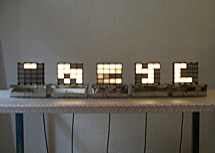
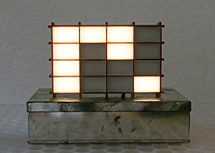
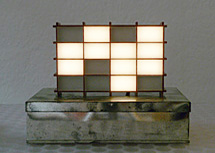
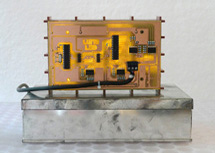
The LUMO LED light-image machine plays a constantly changing sequence of light patterns and shapes on its 16 light chambers. Chaotic formations alternate with geometric and rhythmical ones, lightning effects interfere with softly dimmed transitions. In LUMO LED, the Hauert Reichmuth studio is continuing its development of pixel light machines, making playful reference to the image generators used in the computer art of the 1960s. LUMO LED was designed in collaboration with Volker Böhm..

Sibylle Hauert and Daniel Reichmuth have been working on a joint artistic concept that includes media productions, installations, objects and performances since 1999. They develop and build electronic systems in combination with design software. One of the focal points of their research lies in human-machine interaction and how to stage it spatially. Sibylle Hauert and Daniel Reichmuth live and work in Basel.

video doc
atelier hauert reichmuth


Beat Brogle
One Word Movie
2003
Internet, Video
Conceptual art, Information visualization


“One Word Movie” is an online platform which organizes, based on user-supplied terms, the flood of images on the internet into an animated film. A word turns into images, images turn into a movie. This project plays with the tension between online and cinematic approaches to images. What images are associated whit what words? “One Word Movie” reveals a glimpse into the collective psychology of online cultures by showing patterns of word-image associations, as created by millions of people around the world.
“One Word Movie” is on temporary loan to the DA Collection from Beat Brogle und Philippe Zimmermann.

The Swiss artist Beat Brogle lives in Berlin. His work covers such diverse media as drawing, sculpture, film, video and interactive installations.
“One Word Movie” was programmed by Philipp Zimmermann.


One Word Movie
Beat Brogle


Angela Bulloch
Night Sky Sirius
2007
Wall Object
Light Box


Angela Bulloch engages with the economy and semantics of interplanetary and interstellar relations, their gravitation fields and the kinds of visual representations of the earth, our solar system, and the universe that astronomy has experienced on the way from the age of enlightenment towards globalized pop culture.

Angela Bulloch (born 1966 in Rainy River, Ontario, Canada) is a London and Berlin based sculptor, installation artist and sound artist who is recognised as one of the Young British Artists. She studied at Goldsmiths' College, London (1985 -1988).

Angela Bulloch


collectif_fact
Loading
2006
3D Animation, Video
Loop, web movie


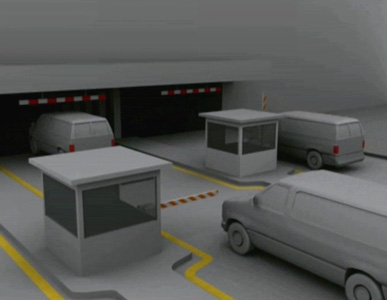
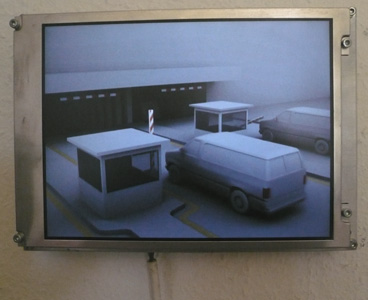
The "loading" video shows the entrance of an underground car park. This space is built in a schematized way, close to the cardboard model. Identical vans continuously enter the building. Only the signposting elements distinguish themselves from the surroundings by their colours.
The action creates a tension linked to the expectation of "an event", while its repetitive side tends to make the scene absurd and disconnect it from its disturbing referent.
Therefore, while reducing elements to a minimum, we provoke a feeling of frustration between what happens and what could occur. (Text collectif_fact)

The group of artists, collectif_fact comprises Annelore Schneider and Claude Piguet (and Swann Thommen up to 2009). Collectif_fact live and work in Geneva.


Loading
collectif_fact


Young-Hae Chang Heavy Industries
View and Plan of Seoul. A Transpacific...
2004
Internet, Animation
Language, Sound, Narration, 56kTv


In 2004 the Korean artists’ collective Young-Hae Chang Heavy Industries developed a spy thriller in 13 episodes as a contribution to the program of the web TV project “56k TV bastard channel”. The plot concerns the report of a female Korean agent. She tells of the El Greco affair and her assignment to kill the cute curator of the Museum of Art in Toledo (Ohio). But as a fan of Critical Theory, she loses herself in a series of mocking reflections on the major and minor factors of globalization, on the graffiti in men’s bathrooms and on a comparison between the concrete architecture in Tokyo and Seoul. “View and Plan of Seoul: A Transpacific Intrigue” combines literary and musical qualities and illustrates them with expressive typographical animation. The rapid rhythm of successive sentences, the constant jumps in the format of the typography, the expressions that are partly colloquial, partly interspersed with phrases from theory and art criticism, are spoken by a computer-generated female voice and turn reading the text into a charming but simultaneously strenuous race. 

Young-Hae Chang Heavy Industries is an American-Korean duo that has been in existence since 1999 and is based in Seoul. The collective works of the author Marc Voge and the artist and translator Young-Hae Chang are characterized by no-frills text animations underpinned by musical rhythms, mostly borrowed from jazz.


View and Plan of Seoul. A Transpacific Intrigue
Young-Hae Chang Heavy Industries


Shu Lea Cheang
Apt
2001
Internet
Interactive Net art


In «Apt» Shu Lea Cheang creates a home for the digitally homeless >> your apartment comes to your desktop wherever you will be in the world >> 400x400 pixels >> It will come through millions of connections >> breaking through into the dark room >> resize it as you like it >> Your apartment is apt >> it is apt for you >> shrinking and expanding the surface of your vision >> apt exemplifies the autopoietic space, the core element of temporalised identity >> expanding into urban landscape and shrinking into an element of identity, called new heimat >> new heimat is always where the user is >> the romantic desire for personal and cultural identity >> in an age of fragmentized, temporalised identites >> "memories dreaming of you" >> "life goes on" >> loading data into the endless black space >> loading data ... loading data ...(Text Hans Dieter Huber)
The work “Apt” is Cheang’s contribution to the online art project “shrink to fit”, which in 2001 addressed questions of the economy of time and attention of online users.

Shu-Lea Cheang sees herself as a cyber nomad; for her projects she lives and works in different places in America, Europe and Asia. The artist, who was born in Taiwan in 1954, began by experimenting with video works and was a member of the Paper Tiger Television collective in New York from 1981. Her well-known multimedia and Internet works include the projects “Bowling Alley” (1995) for the online gallery of the Walker Art Center in Minneapolis and the “Brandon Project” (1996) for the Guggenheim Museum, which was completed in collaboration with other artists. Cheang’s work covers media such as film, video, Net-based installations and online works, and according to the artist herself it examines "ethnic stereotyping, the nature and excesses of popular media, institutional - and especially governmental - power, race relations, and sexual politics."


Apt
Shu Lea Cheang


Exonemo
Danmatsu Mouse Object
2007
Showcase
Object


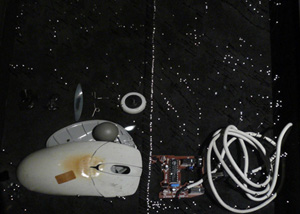
The “5 Danmatsu Mouse Objects” reveal relics and traces of the destructive activities described above in a flat display case: a smashed computer mouse and gleaming silver pins that trace the tracks of the cursor at the moment of its agony against a black background.

The Japanese group of artists Exonemo has been causing a stir in international media art since the end of the 1990s. They have established themselves as important innovators with humorous projects that always reveal reflective depth and aesthetic complexity. They have exhibited their works at institutions such as the Centre Pompidou in Paris and the Mori Art Center in Tokyo, while in 2006 they won the Golden Nica of the Ars Electronica.


Demo version of DanmatsuMouse
exonemo


Hervé Graumann
Lampes code
2003
1 lampe, 4 interrupteurs
Object


Anyone who wants to illuminate Hervé Graumann’s lamp with its four switches in series must first solve a problem of Boolean algebra, as it applies to digital circuits. Each switch has two positions, 1 or 0, on or off. From the position of the switch – up or down (u/d) – you cannot tell with Graumann’s lamp whether the switch in question is allowing the current to flow or not. To produce light, every possible variation of switch combinations must therefore be worked through in a systematic way, to avoid unnecessary repetitions: d-u-u-u, d-d-u-u, d-u-d-u, d-u-u-d, d-d-d-u, d-u-d-d, d-d-u-d, u-d-u-u, etc. It may take a while. George Boole established his logical calculus in 1847.        

Hervé Graumann (1963*) lives and works in Geneva. Since the middle of the 1990s he has been exploring aspects of digital aesthetics and culture in his work. In 1997 he participated in documenta X in Kassel with some of his early online works.


Hervé Graumann


Jodi
Max Payne Cheats Only
2004
machinima movie
Dual Channel video


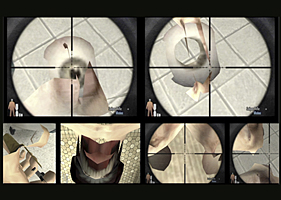
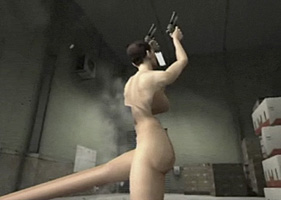
Between 1999 and 2004 Jodi deconstructed a range of commercial ego-shooter games. The result was the work complexes “untitled games” (1999-2001), “Wolfenstein Version” (2001), “Jet Set Willy Variations” (2002) and “Max Payne Cheats Only” (2004).
In “Max Payne Cheats Only”, Jodi takes over the tough third-person shooter Max Payne and uses the tricks built into the game to create for players, who are not aware of what is going on, a continuous cycle that runs through the 3D world of the game and seems absurd. The physical and spatial limits are lifted, the figures in the game race through space like crazed androids. In leaving the realistic 3D graphics of the game in place for its Sisyphean effects, Jodi deconstructs both the heroic pathos and the 3D spatial illusion. To quote Jodi: “We wanted to do something that was non-aesthetically ours. No scary black blobs on jumping white backgrounds, but trying to achieve the impossible - an abstraction within the aesthetic of a game which is already set."
Unlike “untitled games”, “Max Payne Cheats Only” does not offer the viewer any interactive navigation through the world of images, but presents the work as 2-channel video on DVD. It is shown in a 5-copy version on 2 monitors or is presented as a double projection. In addition to the high-resolution version of the work, Jodi offers a website with network videos of “Max Payne Cheats Only” that can be accessed free of charge.

The artists’ collective Jodi consists of Joan Heemskerk (*1968 in Kaatsheuvel, The Netherlands) and Dirk Paesmans (*1965 in Brussels, Belgium). They live and work in Dordrecht in the Netherlands.
The work “Max Payne Cheats Only” was shown at the following exhibition sitest: Künstlerhaus Wien (2010), eARTS BEYOND, Shanghai Contemporary art fair (2009), ArtHouse Austin (2008), Dallas Video Festival (2008), iMAL, Brussel (2008), HTTP Gallery, London (2007), Carlow Arts Festival, Ireland (2007), 11th Rencontres internationales Paris/Berlin, Paris-Villette Theater, Paris (2006), transmediale Berlin (2006), MonteVideo, Amsterdam (2005), Pace Wildenstein, New York (2005), Spacex, Exeter (2004), FACT, Liverpool (2004)

website maxpaynecheatsonly
jodi


Alexander Hahn
A Young Person's Guide
to Walking Outside the City
1983
Animation 2:28
Movie


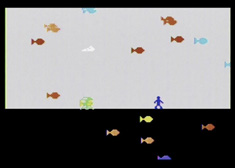
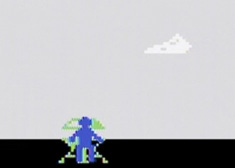
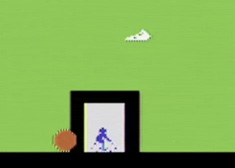
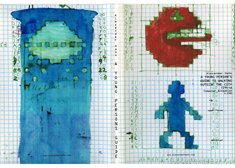
The animation “A Young Person's Guide to Walking Outside the City” was produced in 1983 in the programming language TI Extended Basic on a TI-99/4A home computer from Texas Instruments, using code written or discovered by the programmers themselves. The game is captured using the graphic image aesthetics and linear movements of the contemporary Atari and arcade games, which recall Pac Man (Namco Jp 1980), for example. The DA Collection purchased a copy of the work with exhibition rights in January 2007 on the occasion of Alexander Hahn’s retrospective in the Solothurn Museum of Art.

Alexander Hahn (*1954) lives and works in New York and Zürich. His work explores the shifting realities of everyday life, memory and dream. The method : overtly and covertly recording what's ephemeral and seemingly mundane, then mulling over the various ways these snippets might possibly relate, much like trying to fit the pieces of an unknown puzzle.


video
Alexander Hahn


Esther Hunziker
Frequency
2008
net movie
Video


Signals, noise, frequencies, snatches of sound, distant voices. The movie signal is hardly to be recognized. Blured edges, smeared images. Everything melts. Melts away. The absence of concrete images and the electrospheric soundtrack from overlapping radio frequences, causes a abstract hypnotic void, a space without beginning or end, without clear structures. . . «Frequency»was designed 2008 as a contribution to the online project «beam me up».

Esther Hunziker’s art includes Internet-based works, videos, interactive animations and series of images. Her conceptually-based output unites virtual realities and illusions from the real world. For “nord” she won first prize in 2004 in the “Literatur.digital 2003" competition organized by the dtv publishing house and t-online. Esther Hunziker lives and works in Basel.


Frequency online
Esther Hunziker


Birgit Kempker
Sphinx
2004
Internet, sphinx & machine
Participation, Language, Literature, P2P, 56kTv


She who "sphinxes" answers questions, or rather: answers to them. Thus is the resolute declaration of the Sphinx of Pontresina concerning her own actions. But whose actions are explained? Those of the machine, which answers – in the baroque poetic form of the sestina at that – or the actions of the author Birgit Kempker, the original creator of the project? The Sphinx of Pontresina can be reached via the net: every visitor is encouraged to enter questions, anonymously or revealing their identity, and may expect a direct answer. Kempker distorted and multiplied her own voice using the co-authorship of several machines, the sestina-producing alter-ego as well as several digital voices – thus programming a mixture of direct communication and literary freedom. Seit Herbst 2004 beantwortete die Sphinx über 800 Fragen.

Birgit Kempker: prose, essays, radio plays, art texts, exhibitions, lectures. Professor of Language and Image at the Basel School of Design and since 1990, responsible for setting up and supervising the Language/Literature Department at the F+F School of Art, Zurich.


Sphinx
Birgit Kempker

Marc Lee
TV BOT 1.0
2004
Internet, Multimedia
Information visualization


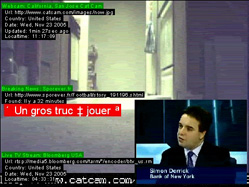
TV Bot by Marc Lee (2004) automatically searches the most recent news items from the Internet and compiles these radio, television, newspaper, and website news - which never are older than one hour – to the world’s possibly most up to date TV program. Since it’s only the novelty criterion that counts – and not in which language the item has been written, which religion or which topic it covers, for instance – TV Bot indiscriminately compiles relevant and irrelevant pictures and news (the most up to date search inquiries on fireball.de, for example) as well as news reports from the most varied continents and cultures, and puts together, from these, a television program almost made from one casting. (Inke Arns)

“TV Bot 1.0” was designed in 2004 as a contribution to the online project “56kTV bastard channel”.

Marc Lee works as a media artist, graphic designer and software developer. Since 1999, his network-oriented, interactive projects have been pursuing an approach to production that has an artistic orientation. Lee experiments with information and communication technologies and locates clusters of themes that are important for communication processes in digital networks. News items prepared by journalists play a central role in this work, which can also be understood as a critical analysis of the susceptibility of the media to manipulation.

Video-Documentation TV-BOT 1.0 (Nov 23 2005)
Text concerning TV-BOT 1.0byn Inke Arns, Dortmund 2004
Marc Lee


Marc Lee
TV BOT 2.0
2010
Internet, Multimedia
Information visualization


TV Bot by Marc Lee (2004 / 2010) automatically searches the most recent news items from the Internet and compiles these radio, television, newspaper, and website news - which never are older than one hour – to the world’s possibly most up to date TV program. Since it’s only the novelty criterion that counts – and not in which language the item has been written, which religion or which topic it covers, for instance – TV Bot indiscriminately compiles relevant and irrelevant pictures and news (the most up to date search inquiries on fireball.de, for example) as well as news reports from the most varied continents and cultures, and puts together, from these, a television program almost made from one casting. (Inke Arns)
“TV Bot 2.0” is a restored and updated version of the TV Bot, which accesses flash streams rather than real streams. “TV Bot 2.0” was developed in 2010 as a contribution to the online project “beam me up”.

Marc Lee works as a media artist, graphic designer and software developer. Since 1999, his network-oriented, interactive projects have been pursuing an approach to production that has an artistic orientation. Lee experiments with information and communication technologies and locates clusters of themes that are important for communication processes in digital networks. News items prepared by journalists play a central role in this work, which can also be understood as a critical analysis of the susceptibility of the media to manipulation.

TV-BOT 2.0
Comment on the restaurative aspect of TV-BOT 2.0 (Tabea Lurk, 2010)
Marc Lee


Julian Opie
Walk
2009
Animation on LED display
Animation


The LED animation “WALK” by Julian Opie uses red dots to show the movements of legs walking beneath the gently undulating hem of a skirt. With a minimum of image information, the short loop traces an astonishingly natural and graceful walk. Opie’s walking woman’s torso is a digital descendant of Rodin’s "L'homme qui marche".

Computer animation on LED display / Edition of 200 / Size h: 25.6 x w: 13.4 x d: 4.2 cm
With his animations of walking people, Julian Opie (London, *1958) is one of the best known artists working with digital media internationally.

Walk
Julian Opie


Karin Sander
Projekt „Unlimited“, Portrait R.S.
2001
3D-Print, rapid prototyping
Object


In the exhibition "art unlimited" at ART 32 Basel 2001, visitors were able to have small sculptures of their own figures made using Karin Sander’s concept of digital scanning and 3D printing processes. Sander’s sculptures, which use a scale of 1:7.7, leave the design and expression of the figures on the one hand to the people being portrayed themselves and on the other to the disinterested eye of the digital cameras that scan them. To this extent, “unlimited” is a conceptual work, but one that deals with classical themes of the visual arts concerning portraits and self-portraits, and at the same time constitutes (three-dimensional) photography as figurative sculpture.

Karin Sander’s artistic work has been shown in numerous international exhibition projects. Her works are in private and public collections, such as … Since 1 September 2007 Karin Sander has been Professor of the Fundamentals of Design, Art and Architecture at the ETH Zurich.

Karin Sander


Huang Shi
Drift Bottles (Flaschenpost)
2006
Interactive Installation
Participation, Messages


One participant opens the top of Huang Shi’s “Drift Bottle”, says a few words into the empty bottle and closes it again. As soon as the next visitor opens the bottle, he hears those words. He too is then asked to leave a message after the beep for the next visitor. When they have been heard once, all of the messages are permanently deleted. The “Drift Bottles” have been on show at exhibitions of the ISEA2006 in San Jose, at the 3rd Beijing International New Media Arts Exhibition and in "New Directions from China" at the Plug.in Basel in 2007.

Huang Shi was born in north-western China in 1979. He completed his studies in the Department of Information Art and Design, Academy of Art and Design of Tsinghua University, graduating with a PhD.


John F. Simon, Jr.
Every Icon, Edition Number 118 + 126
1997
Internet, java applet
Conceptual art, time visualization


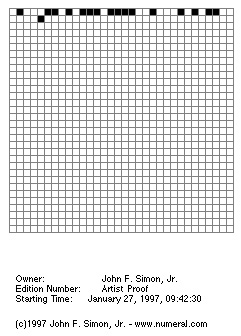
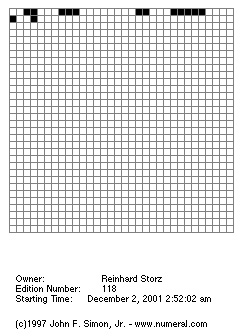
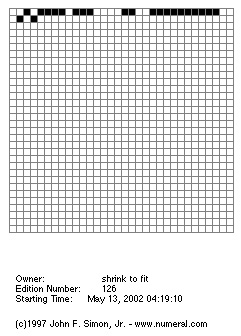
On 27 January 1997 at 09:42:30 the graphics program consisting of 32 x 32 white panels began. At the top left, the Java applet started a countdown, as black panels started to join together, moving to the right from field to field at a pace that halved with every panel. The exponentially declining speed with which the black panels move to the right and downwards communicates a perception of time that is not that of human beings. In the artist’s estimation, it will take 16 months to play out all of the 4.3 million combinations of white and black panels on the top line. To complete the second line, it will take about 6 billion years. The title of the work, “every Icon”, plays on the fact that over the period that it will take for all the panels to turn black, to which it is almost impossible to attach a figure, all of the image combinations, both identifiable and meaningless, will appear that it is possible to construct on a fremework of 1024 panels.
In the early years, Simons offered personalized versions of his work through Amazon, of which 2 are in the possession of the DA Collection.

John F. Simon's work covers a wide variety of forms of computer-based images and objects. The artist lives and works in New York.

Every Icon
John F. Simon, Jr.


Cornelia Sollfrank
Net Art Generator
2003
Internet, Software/Game
Conceptual art, Media activism, Technology


Cornelia Sollfrank’s Net art generators are computer programs (Perl scripts) that create a collage of new websites or images from text or image materials found on the Net when a search word is entered. Since the first experiments with randomly generated “works of art” for the project Female Extension in 1997, five different generators have been created, the functions of which have become increasingly sophisticated and the results of which are correspondingly ever more complex. The programs have been created in collaboration with various programmers. The code of all the Net art generators can be downloaded as free software from the homepage - a clear indication that Sollfrank not only wants to raise artistic authorship as a matter for discussion, but also to makes it widely accessible.

Cornelia Sollfrank initially studied painting at the Academy of Visual Arts in Munich and the University of Visual Arts in Hamburg. Assuming a variety of roles – hacker, cyber feminist and Net artist – she explores the global communication systems. Her translation of artistic-subversive strategies into the digital medium constitutes deliberate provocations of the art system, which is still based primarily on the concept of authorship by individual geniuses and in which female authors are still in the minority, not least in the New Media.

Net Art Generator


Monica Studer/Christoph v d Berg
Still Life Take-Away
1998
Internet, Objekt/Installation
Conceptual art, Digital, Prints, Shop


In “Still Life Take-Away” from 1998, Monica Studer and Christoph van den Berg anticipated the practice of online shopping which has now become established for many consumer goods and services. Making reference to the traditional genre of still life, the homepage offers a range of objects from the home and workshop that users can select as the basis for an individual composition. The artistic idea of converting the object into an image ennobles a piece of string or foil, a sponge or some bathroom tissue; and selecting an object obliges the user to make a purchase: the exclusive print produced by the pair of artists from the selected objects is sent to the user with an invoice. The online shop has been closed for a company vacation since 2001, however.
“Still Life Take-Away” is on loan to the DA Collection from Monica Studer and Christoph van den Berg.

With works such as “Legende” (1994), “Wie man eine Seele baut” (1997) and “Vue des Alpes” (2001), Monica Studer and Christoph van den Berg were among the first Swiss artists to address both the conceptual and aesthetic possibilities of digital works of art in a highly reflective way.

Still Life Take-Away
Monica Studer / Christoph van den Berg


Monica Studer/Christoph v d Berg
travelogue
2005
Internet, 3D images
Game Art, interactive movie, 56kTv


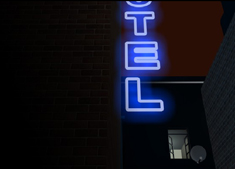
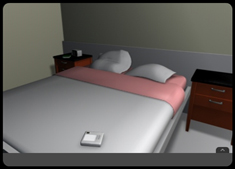
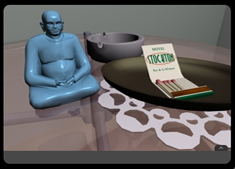
The »Travelogue« game was developed by Monica Studer and Christoph van den Berg in 2004/2005 as a contribution to the online project 56kTV bastard channel. Travelogue falls into the game art category. In the virtually accessible image space of a hotel room, the player/viewer of the work has to complete various tasks requiring significant combinative efforts and differing approaches until he or she finds the exit from the image prison (hotel room). This artistic game develops an image story, the progress of which must be interactively discovered through playing the game.

With works such as “Legende” (1994), “Wie man eine Seele baut” (1997) and “Vue des Alpes” (2001), Monica Studer and Christoph van den Berg were among the first Swiss artists to address both the conceptual and aesthetic possibilities of digital works of art in a highly reflective way.


play the game
essay on the game by Claus Pias
Monica Studer / Christoph van den Berg


Olaf Val
Display
2003
12 Displays
interactive Installation


Behind each of the dot matrix components of the wall installation, a circuit board with a microprocessor is installed, which is supplied with power through two enameled cables. A further cable serves to network the individual displays. Unlike most test arrangments that investigate the structures resulting from the definition of neighboring conditions (cellular automata), modularity is not simulated in the wall installation “Display”. Each display does actually work autonomously and impulses are actually exchanged between neighboring displays. While dot matrix displays, such as those in elevators, normally produce recognizable symbols, the individual programs of the displays do not depict any legible, emblematic designs. Only by looking at them for a long time can the system of rules that controls the points of light be recognized.


Display
Olaf Val


Jan Voellmy
Schnur
2008
Istallation, Software
Interactive, intermedia


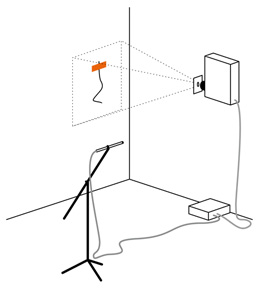
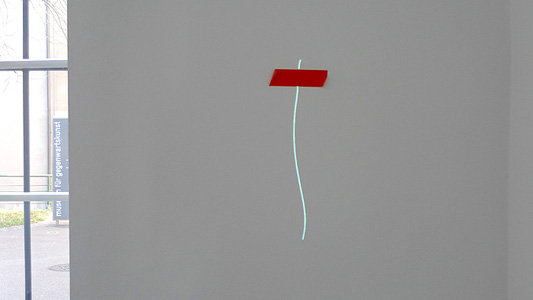
The image of a thread stuck to the wall with tape is projected on to another wall. A microphone stands in front of it. The tones and sounds picked up by the microphone move the thread, making it vibrate gently, twitch or even curl up completely, depending on the intensity.

Jan Voellmy (*1978) is a freelance graphic designer and artist living in Basel.

Schnur Movie
Jan Voellmy